Leak Detection Edinburgh
If you are dealing with a hidden leak in an Edinburgh flat, house, or shared building, the first useful step is to establish the source properly before anyone commits to the wrong repair.
We provide leak detection across Edinburgh with a careful, evidence-led approach, written findings, and repair where the repair is within scope.
- Scottish Water has flagged a possible leak
- Boiler pressure keeps dropping with no visible cause
- A damp patch is spreading across a ceiling or wall
- Water is affecting the flat below
- The issue may involve a tenement, shared pipework, or a common part
- The property is older, listed, or sensitive and you want a careful approach
Visible staining is often not the real source
Leak investigation in Edinburgh is rarely straightforward. Water can travel through older fabric, shared building routes, and concealed structures before it becomes visible.
That matters in New Town, Old Town, Marchmont, Bruntsfield, Leith, Stockbridge, Morningside, Portobello, and other older or shared-building areas where the visible stain is often not the source.
Common concealed routes
- Old floor voids
- Lath-and-plaster partitions
- Shared risers
- Stone walls
- Basements
- Tenement structures
Property type changes the investigation
New Town, Old Town, Marchmont, Bruntsfield, Leith, Stockbridge, Morningside, and Portobello
Older or shared-building areas often show visible staining far from the true source because water can travel through older fabric and communal structures.
Shared buildings and tenements
The first question is often not only how to repair the issue, but where the source actually sits.
Older, listed, or sensitive properties
Careful diagnosis matters because the wrong repair can create unnecessary disruption and cost.
Areas we cover across Edinburgh and the Lothians
We cover Edinburgh city and the surrounding area, including: New Town · Old Town · Marchmont · Bruntsfield · Leith · Stockbridge · Morningside · Portobello · Corstorphine · Murrayfield · Gorgie · Dalry · Liberton · Gilmerton · Cramond · Juniper Green.
We also cover the wider Lothians: Musselburgh · Dalkeith · Penicuik · Loanhead · Bonnyrigg · South Queensferry · Livingston.
We operate from a Central Scotland base and cover Edinburgh as part of our core service area. Send your postcode if you want to confirm before booking.
Relevant service routes for common local scenarios
Central heating leak detection
For recurring pressure loss and concealed heating-system leaks.
Mains and underground leak detection
For Scottish Water letters, unexplained water use, and suspected buried supply leaks.
Bathroom and wet room leaks
For water affecting the room below or recurring moisture around bathrooms and shower areas.
Roof and building-envelope investigation
For ceiling staining after rain and cases where it is unclear whether the source is plumbing or building-related.
Trace and access documentation
Where relevant, we provide trace and access reporting: a written record of what was investigated, what was found, and what work was carried out.
A careful process from symptom to documented result
You tell us what you are seeing
We start with the symptom, the property type, how long it has been happening, and what anyone has already tried.
We assess the likely type of problem
Before the visit, we consider whether this looks more like a plumbing leak, a heating-system leak, a buried supply issue, or a shared-building problem.
We investigate methodically on site
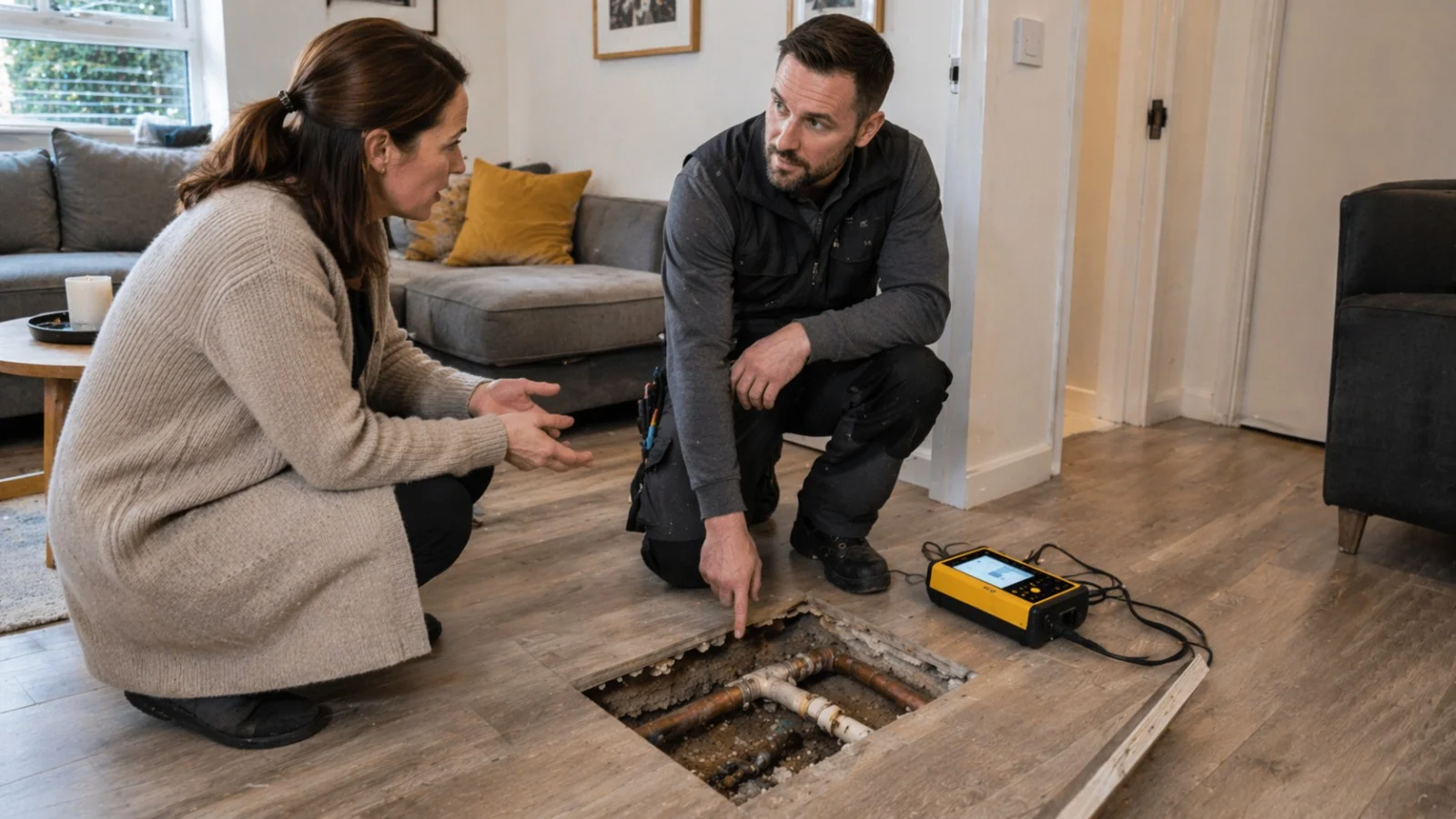
Depending on the property and the issue, that may include thermal imaging, acoustic testing, tracer gas, moisture mapping, pressure testing, or targeted inspection tools.
We explain what the findings mean
If an active leak is identified, we explain where it is and what the next step is. If the result points away from plumbing, that is still useful because it helps avoid the wrong repair.
We document the result and repair where within scope
You receive written findings and photos, together with a summary of the likely cause and next action. Where repair is within scope and access allows, we aim to complete it.
Source evidence usually comes before responsibility
Some buildings policies include trace and access cover. We can provide the documentation your insurer may request, but we do not advise on policy entitlement or guarantee insurer decisions.
If the property is part of a tenement or another shared building, source evidence usually comes before any clear answer on responsibility.
This distinction is vital when handling an insurance claim for water damage, as accurately locating the source ensures the right parties are involved and the claim is processed effectively.
If the leak is part of an insurance claim
If your insurer has asked for a trace and access report, or if you're in the early stages of an escape of water claim, we can provide the written findings and documentation they typically request.
For help with the insurance claim itself (what your policy should cover, how to avoid common reasons claims get underpaid, and whether it's worth appointing a loss assessor before the insurer sends their own) speak to the team at PCLA who will cover this in detail with you.
Questions Edinburgh clients usually ask first
Will leak detection damage my floors or walls?
The aim is to test before opening up. Where access is likely to be needed, that should be explained first.
I live in a tenement. Who is responsible?
That depends on where the source is. The practical first step is identifying whether the issue sits within your flat, another flat, shared pipework, a common area, or the building envelope.
What if no active leak is found?
That is still useful. A documented investigation can rule out specific causes and redirect the next step properly.
Can you provide a report I can use afterwards?
Yes. We provide written findings and photos with a clear summary of the investigation and the result.
You're based in Stirling — do you cover Edinburgh?
Yes. Edinburgh is part of our core service area. Most visits are arranged within one to two days. Send your postcode if you want to confirm before booking.
Need leak detection in Edinburgh?
Tell us what you are seeing, the property type, and whether the issue involves another flat, a factor, or a Scottish Water letter. We will explain the most sensible next step.