Lead pipes
Often found in older properties. They can fail through age, joint weakness, or corrosion and may respond well to acoustic methods.
Noticed a wet patch in the garden, a spinning meter, or a sudden rise in water use?
We locate hidden supply pipe and underground water leaks accurately, before unnecessary digging starts.
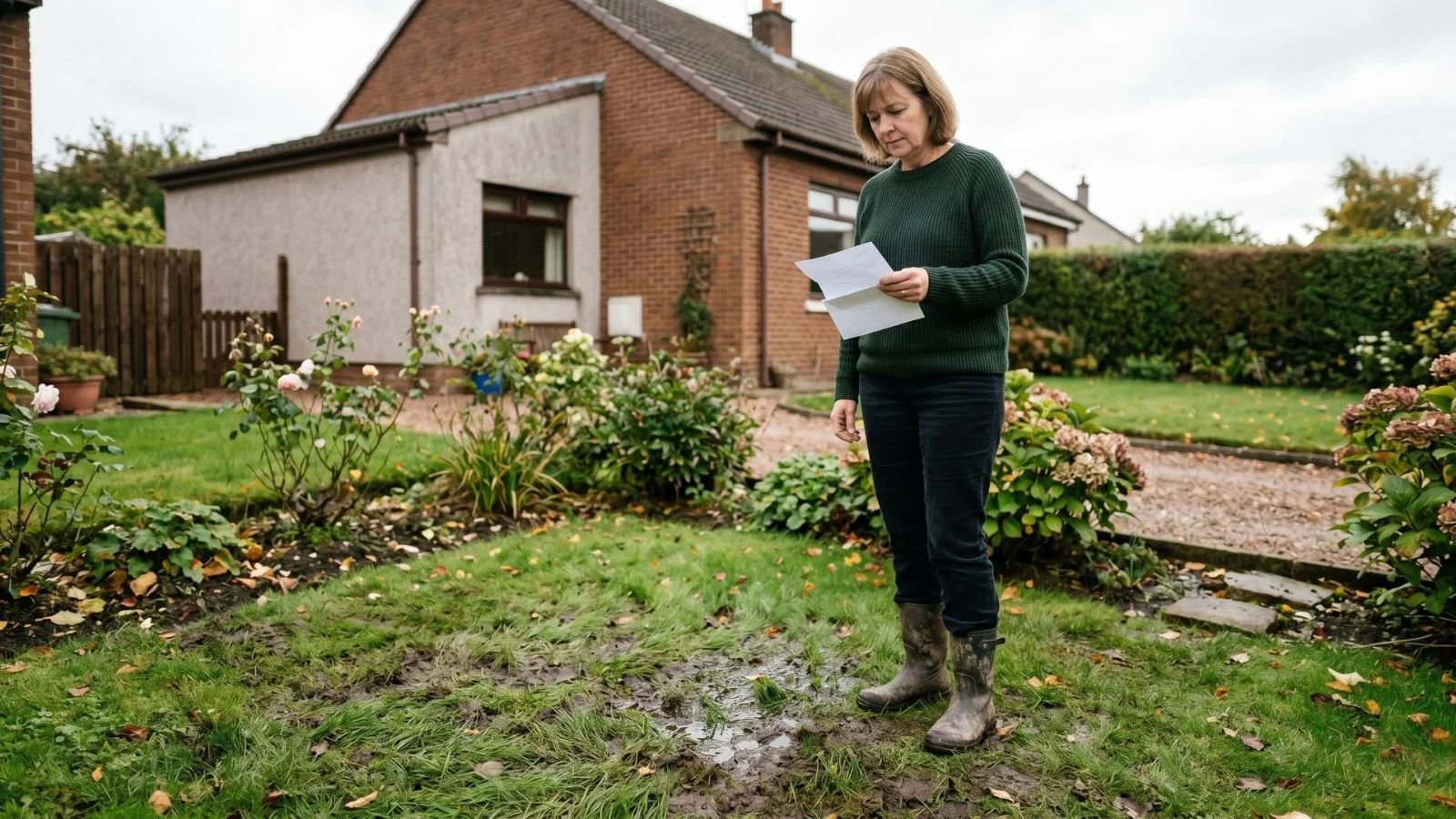
If Scottish Water has contacted you about a possible leak, the issue is often not the public main in the road. In many cases, it relates to the supply pipe serving your property — the section that may run beneath your garden, path, driveway, or forecourt before entering the building.
That is why these letters create so much stress. The leak is usually hidden, there may be little or no visible surface evidence, and until the source is confirmed, it is difficult to know what action to take next.
Scottish Water has identified water use or loss patterns that suggest there may be an active leak affecting your supply.
A hidden underground leak can continue for weeks or months without obvious signs. Left unresolved, it may lead to ongoing water loss, soft ground, damage to hard landscaping, or further action from Scottish Water.
Find the source first. Once the leak location is confirmed, you can decide on repair, responsibility, and what documentation you may need.
It is there for a reason, and delays rarely make the situation easier.
With all taps and water-using appliances off, any movement may indicate an active leak.
If it is safe to do so, isolating the supply can help reduce ongoing loss.
Randomly lifting slabs or breaking out a driveway is expensive and often misses the actual source.
A structured leak detection visit is designed to locate the source before access is agreed.
Responsibility often depends on where the leak is. Scottish Water is generally responsible for the public water main. The supply pipe serving your property is often your responsibility once it leaves the public network and crosses into the private side of the boundary. That is why locating the source comes first. This responsibility-first framing reflects the project’s Scottish context guidance and the need to establish ownership before action.
You do not need a Scottish Water letter to have a genuine underground leak problem. Many people call because something feels wrong but the source is not obvious.
You have a wet, soft, or spongy patch outdoors.
If the ground stays damp without recent heavy rain, water may be escaping below the surface and saturating the surrounding area.
There is unexplained water pooling near a driveway, path, or boundary.
Leaks beneath hard surfaces often show themselves only when water begins finding a route to the surface.
Water pressure seems lower than normal.
A loss of pressure can mean water is escaping before it reaches the property properly.
You can hear unusual gurgling or water movement.
Air entering the system, or water escaping under pressure, can create sounds that do not match normal use.
The problem has already been looked at, but nothing was found.
That is one of the most common reasons people call a leak detection specialist. General plumbing call-outs are designed to repair visible faults. Underground supply pipe leaks usually need a different kind of investigation. That distinction is explicitly supported by the project’s behavioural guidance.
Your water meter moves when everything is off.
This often points to an active leak on the supply pipe or another hidden section of pipework.
Underground leaks are easy to underestimate because the damage is often out of sight. What matters is not guessing where the leak might be, but narrowing it down properly so the repair can be targeted and the access kept as controlled as possible.
Quick Answer
Scottish Water is usually responsible for:
The public water main in the road or pavement
Faults on the public side of the network
You may be responsible for:
The supply pipe serving your property after it leaves the public network
Pipework running across private ground to your internal stop tap
Internal pipework within the property
In some older properties, tenements, or buildings with shared arrangements, more than one property may be served by part of the same supply route.
In those cases, the first priority is still the same: establish exactly where the source is and which section of pipework is affected.
Once that is clear, responsibility becomes much easier to discuss with neighbours, a factor, or any other involved party.
We follow a structured process designed to reduce guesswork and avoid unnecessary excavation.
We start by understanding what you have seen so far and, where relevant, checking the meter behaviour and isolating parts of the system to confirm whether the issue appears to be on the supply side or elsewhere.
Pressurised water escaping from a buried pipe often creates a detectable sound. We use specialist acoustic equipment to listen along the likely pipe run and narrow down the area of interest.
On longer or more accessible runs, correlation can help compare signals across the line and improve accuracy before any access is discussed.
Where acoustic methods are less effective — often with some plastic pipework — tracer gas can be introduced and detected at surface level to help pinpoint the source.
If the route of the underground pipe is uncertain, additional investigation may be needed before the final leak location is confirmed.
Once we have identified the most likely point of failure, we mark the area clearly so that any excavation or access can be confined to the smallest practical area.
You receive a clear record of what was investigated, what was found, and the recommended next step. Where relevant, this can support a trace and access claim by providing the documented evidence insurers typically ask for.
The type of underground pipe serving the property can affect how the leak is best traced.
Often found in older properties. They can fail through age, joint weakness, or corrosion and may respond well to acoustic methods.
Usually good candidates for acoustic detection, particularly where the route and access points are reasonably clear.
Common in newer installations and replacement works. These often transmit sound less clearly, which is why tracer gas may be the more effective option.
You do not need to know which pipe type you have before calling. Part of the job is working that out and choosing the most appropriate method from there.
The type of underground pipe serving the property can affect how the leak is best traced.
Where multiple flats are served from a shared arrangement, the key issue is often not just the leak itself but proving which section has failed and who needs to act next.
Older frontages and harder surfaces make speculative excavation costly. Accurate detection matters because unnecessary access can create avoidable reinstatement work.
Long runs beneath driveways, paving, and landscaped areas can make underground leaks expensive to chase without proper testing first.
Longer supply runs and less obvious access points can make the source harder to confirm without a structured investigation.
Financial anxiety is often what stops people from booking, especially after a leak letter or when the likely repair route is unclear.

Many buildings insurance policies include trace and access cover — meaning cover for the cost of locating a hidden leak and gaining access to it. Whether that applies depends on your policy wording. We can provide written findings, photos, and a summary of what was located and what work was carried out, in a format your insurer may request. This is the approved way to describe that support in the project materials.
Where Scottish Water has flagged a leak and a repair is completed within the required process, there may be a route to apply for a reduction relating to abnormal usage or leakage. The exact criteria depend on Scottish Water’s scheme and current requirements. What matters on our side is providing clear evidence of the source and the work completed where that is within scope.
We do not manage claims or make decisions on behalf of Scottish Water or your insurer. What we provide is the evidence: what was found, where it was, and what was done next. That boundary is required by the brand constraint guide and FAQ database.
We do not hide pricing behind vague forms. The cost depends on the property type, the likely pipe route, and which detection methods are needed.
| Service Type | Includes |
|---|---|
| Underground supply pipe investigation | from [£450] Includes initial assessment, appropriate detection methods, surface marking, and written findings with photos. |
| Tracer gas investigation | from [£450] Used where pipe material or site conditions make tracer gas the more appropriate method. |
| Combined investigation | from [£450] For more complex cases where more than one method is needed to narrow down the source confidently. |
| Urgent attendance | subject to availability. Call with your postcode and a description of what is happening and we can advise if you need an emergency leak response. |
Final cost is confirmed after telephone triage.
The investigation fee covers locating the source.
Repair work is scoped separately once the location and access requirements are clear.
Where repair is within scope, we can explain the next step there and then.
We agree scope before work starts.
If you have already had someone out and the source still is not clear, the real cost is usually not the first call-out. It is the second, third, and fourth attempt, the disrupted paving, the unnecessary excavation, and the time lost while the leak continues.
A specialist underground leak investigation is often the sensible next step because it gives you:
a clearer diagnosis,
a more targeted repair point,
less guesswork,
and a written record of what was found.
Before you call
Can't find the answer you need?
Call our team on 01786 619 110Still not sure what you need?
A brief conversation is usually enough to point you in the right direction.
Call us to describe what you are seeing. We can usually advise whether an underground leak investigation is the right next step.
Or request a callback and we’ll get back to you as soon as possible.
SNIPEF Accredited Insurance-report ready Non-invasive methods Nationwide coverage
