
Roof & Building Envelope Leak Detection
If a ceiling stain gets worse after rain, a flat roof has already been patched without solving the problem, or nobody agrees whether the source is roof-related or something else, the first step is to establish where water is actually getting in.
We investigate roof and building-envelope leaks across Stirling, Glasgow, Edinburgh, and the wider Central Belt with a structured, evidence-led approach.
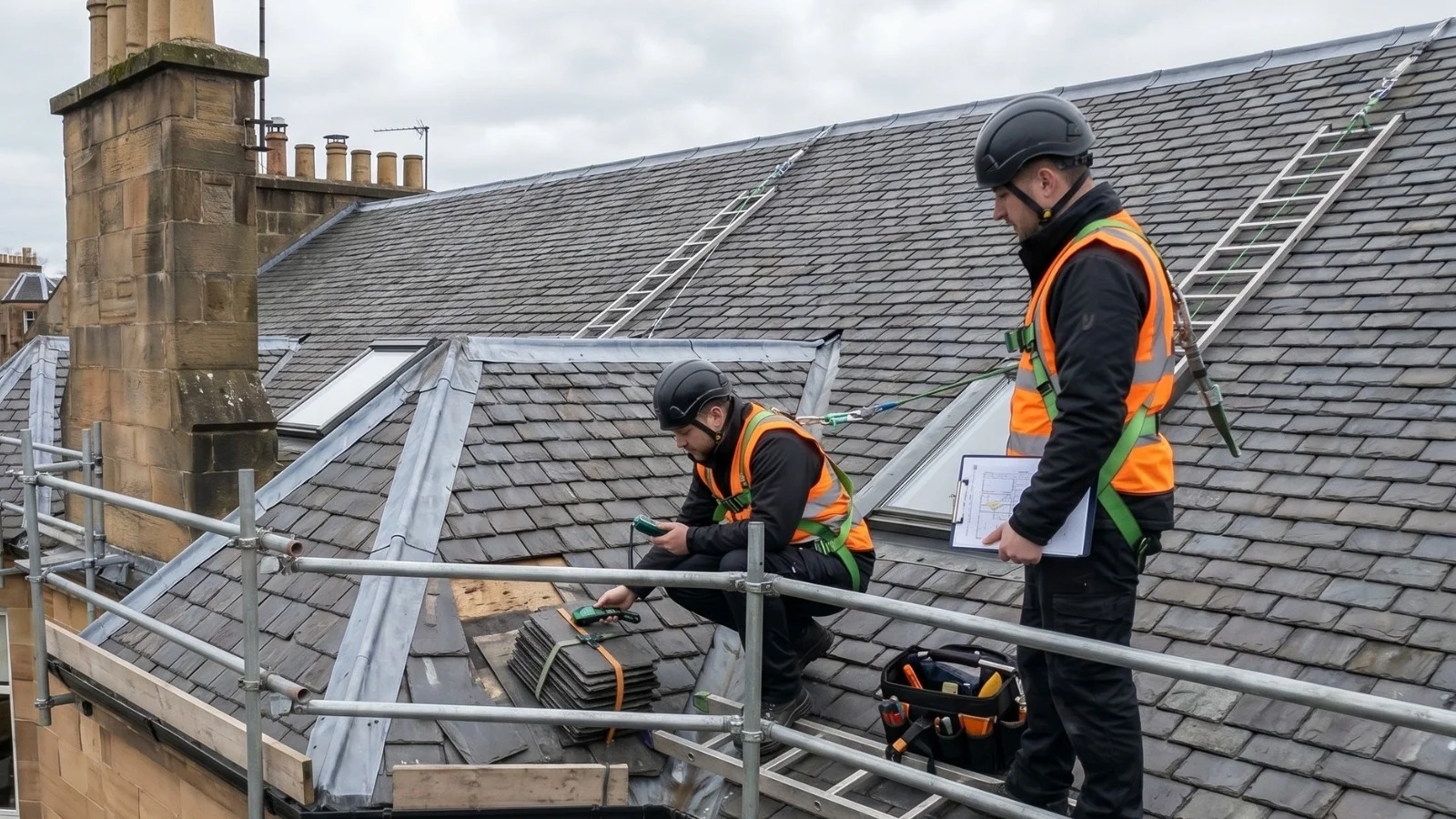
- Roof leaks rarely show exactly where water gets in
- Repeated patch repairs can miss the true ingress point
- Shared-building leaks often involve disputed responsibility
- Clear findings help the next contractor or insurer act properly
When this page is usually relevant
- Damp patch on a ceiling after rain
- Repeated roof repairs that have not stopped the leak
- Top-floor flat or tenement leak with disputed responsibility
- Building-envelope leak affecting a commercial or mixed-use property
Visible damage is often not the entry point
With roof and building-envelope leaks, water rarely appears exactly where it enters.
It can travel beneath coverings, through insulation or decking, behind parapets and abutments, along concealed junctions, or through shared roof voids in older buildings.
That is why repeated patch repairs can fail when the visible defect is not the actual ingress point.
Common water paths
- Beneath coverings
- Through insulation or decking
- Behind parapets and abutments
- Along concealed junctions
- Through shared roof voids in older buildings
How we narrow the source down before disruptive access
We start with the symptom pattern
We look at when the issue appears, how the staining behaves, what has already been tried, and what kind of roof or envelope detail is involved.
We assess likely ingress paths
That may involve coverings, flashings, parapets, outlets, penetrations, or concealed junctions.
We use suitable methods
Depending on the property and conditions, that may include thermal imaging, moisture mapping, and other targeted investigation methods.
We verify before recommending access
We do not treat broad exploratory strip-back as the default. We narrow the problem down first.
We document the findings clearly
You receive written findings, photos, and a clear explanation of what appears to be happening and what the next step should be.
Local property types change how roof leaks behave
Glasgow tenements and traditional roofs
Water can track through shared roof structures and appear far from the true ingress point.
Edinburgh traditional and historic properties
Complex roof details and sensitive building fabric often make careful diagnosis more important than quick assumptions.
Flat roofs and extension roofs
Repeated patching is common, especially where the surface issue looks obvious but the actual water path is wider or different.
Commercial and mixed-use buildings
The investigation often needs to balance occupied-space disruption, documentation, and multiple stakeholders.
Built for the people who need a usable answer next
Homeowners and top-floor flat owners
You need to know whether the issue is likely to worsen, whether the source appears private or shared, and what to do next.
Landlords and letting agents
You need a dated investigation and written findings that help you respond properly and decide whether the issue sits within the let property or a shared element.
Commercial and block-managed properties
You need controlled disruption, clear findings, and documentation that others can act on.
Evidence often matters before the next conversation can happen
If insurance is involved, we can provide the documentation your insurer may request. Whether the policy responds depends on the wording and the insurer's decision.
If the issue appears to involve a common roof, shared guttering, or another shared building element, source evidence is often the starting point for the next discussion with a factor, neighbour, contractor, or insurer.
Useful outcomes from a visit
- Written findings dated to the investigation
- Photos and source-focused documentation
- Clearer handover to the next contractor
- Better footing for insurer or shared-building discussions
Questions people usually ask before booking
Will you need to strip the roof to find the source?
Not as a starting point. The goal is to narrow the likely ingress area before any disruptive access is recommended.
My roofer says the roof looks fine. Could it still be roof-related?
Yes. Water ingress can travel through concealed paths and may not line up neatly with the most obvious visible defect.
Can you tell whether it is a roof leak or condensation?
That is often exactly why an investigation is useful. The aim is to separate likely ingress from other moisture-related causes before the wrong repair is attempted.
Do you repair the roof as well?
This page is about locating the source and documenting it clearly. Wider roofing or reinstatement works should be treated as a separate scope unless specifically agreed.
Need a clearer answer before more patching or more damage?
Describe what you are seeing, what happens after rain, and what has already been tried. We will explain whether this kind of investigation is likely to help.