Leak Detection Glasgow
If you are dealing with a damp patch, water from the flat above, recurring boiler pressure loss, or a leak that nobody has been able to pin down properly, the first useful step is to confirm the source.
We provide leak detection across Glasgow — from West End tenements to Southside conversions and mixed-use buildings throughout the city — with a methodical approach, written findings, and repair where the repair is within scope.
- Boiler pressure keeps dropping with no visible leak
- Water is coming through into the flat below
- Damp patch is spreading across a ceiling or wall
- A previous repair did not solve the problem
- Scottish Water has told you there may be a leak
- Nobody agrees whether the issue is private, shared, or from another flat
Responsibility often depends on where the source actually sits
In Glasgow, leaks often involve tenements, converted flats, older pipework, shared risers, and mixed-use buildings where water can travel far from the original source.
The key question is often not only how to repair the issue, but where the source actually sits. Until that is clear, responsibility and repair scope often remain disputed.
The source may sit
- Inside your flat
- In the flat above
- In shared pipework
- In a communal area
- In the building envelope
Different property types create different leak paths
Tenement flats
Leaks often cross ownership boundaries and appear far from the actual source.
Older houses and conversions
Concealed pipework and layered alterations can make the visible symptom misleading.
Managed and mixed-use buildings
Documentation matters because several parties may need the same findings before anything moves forward.
Areas we cover across Glasgow
We provide leak detection across Glasgow and the surrounding area, including: West End (Partick, Hyndland, Kelvinside, Broomhill) · Southside (Shawlands, Pollokshields, Govanhill, Battlefield, Clarkston) · East End (Dennistoun, Parkhead, Shettleston) · North Glasgow (Maryhill, Possilpark) · City Centre · Bearsden · Milngavie · Rutherglen · Cambuslang · Newton Mearns · Paisley.
We operate from a Central Scotland base and cover Glasgow as part of our core service area. If you're unsure whether we reach your postcode, send it and we'll confirm.
Relevant service routes for common local scenarios
Central heating leak detection
For recurring pressure loss and concealed heating-system leaks.
Mains and underground leak detection
For Scottish Water letters, supply pipe concerns, and hidden external leaks.
Bathroom and shower leaks
For water tracking into the room below or repeated bathroom-related problems.
Roof and building-envelope investigation
For rain-related staining, top-floor leaks, and uncertainty over whether the source is internal or external.
Trace and access documentation
If you need written findings and photos for an insurer, factor, or shared-building discussion, we can provide the documentation they may request.
A methodical process before repair decisions
We start with the symptoms
We look at what you are seeing, where it is showing up, and what has already been tried.
We investigate methodically
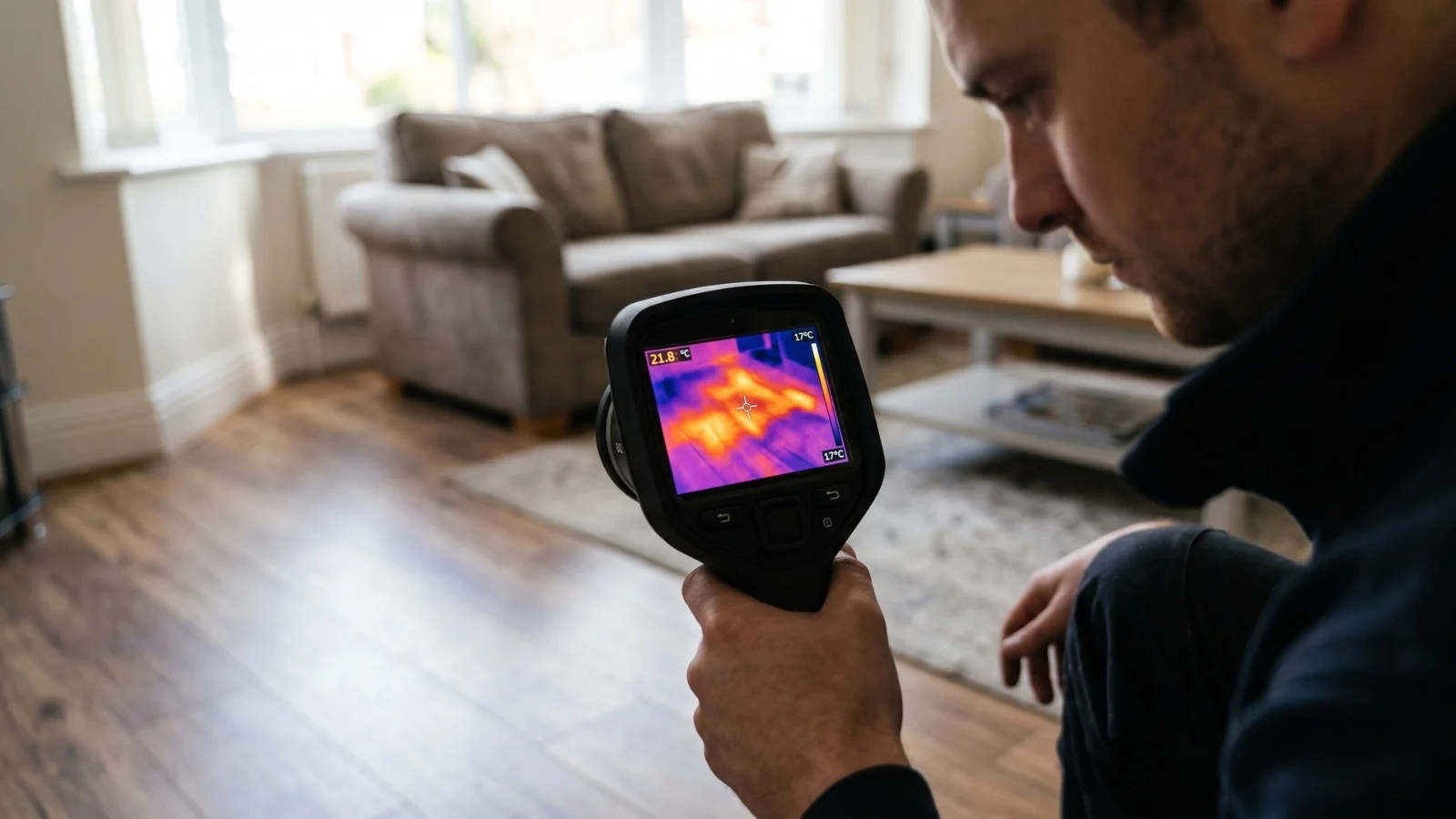
Depending on the property and the symptom pattern, that may include thermal imaging, acoustic testing, tracer gas, moisture mapping, or other appropriate methods.
We explain the findings clearly
You are told what appears to be causing the problem, where the source is, and what the next step should be.
We repair where within scope
Where the plumbing repair is within scope and access allows, we aim to complete it. If wider works are needed, we explain that separately.
Source evidence often comes before responsibility
If insurance is involved, we can provide written findings and photos that your insurer may request. Whether the policy responds depends on your wording and your insurer's decision.
If the issue involves a factor, a neighbour, or another flat owner, source evidence is often the practical starting point before responsibility becomes clearer.
Identifying the true source of the problem is crucial when making an escape of water insurance claim, as it ensures the full extent of the damage is properly assessed and covered.
If the leak is part of an insurance claim
If your insurer has asked for a trace and access report, or if you're in the early stages of an escape of water claim, we can provide the written findings and documentation they typically request.
For help with the insurance claim itself (what your policy should cover, how to avoid common reasons claims get underpaid, and whether it's worth appointing a loss assessor before the insurer sends their own) we recommend that you speak to the team at PCLA.
Questions Glasgow clients usually ask first
Who is responsible for a leak from the flat above in a Glasgow tenement?
That depends on where the source actually sits. The first step is establishing that clearly.
What does a Scottish Water leak detected letter mean?
It usually means there may be a leak affecting the supply linked to your property. Locating the source helps you understand what needs to happen next.
Can you repair the leak on the same visit?
Sometimes, yes, where the repair is within scope and access allows.
Do you cover surrounding areas as well?
Yes. If you are near Glasgow and unsure, send the postcode and we will confirm.
You're based in Stirling — do you actually cover Glasgow?
Yes. Glasgow is part of our core service area. Most visits are arranged within one to two days. Send your postcode if you want to confirm coverage before booking.
Will my insurer accept your trace and access report?
We provide written findings, photos, and documentation in a format insurers typically request. Whether your policy responds to the claim depends on the policy wording and your insurer's decision (that's outside our scope), but the documentation we produce is the starting point.
Need leak detection in Glasgow?
Tell us what you are seeing, the property type, and whether the issue involves another flat, a factor, or a Scottish Water letter. We will explain the most sensible next step.